
Common SEO mistakes that are hurting your website ranking** can be difficult to identify, especially when your website looks professional and your content seems valuable. You may have a beautiful website, publish blogs regularly, and use relevant keywords, yet your pages may still struggle to appear on Google.
The reason? SEO is not just about adding keywords to your content. Search engines consider hundreds of signals when determining which pages deserve to rank higher. Technical issues, poor website structure, slow loading speed, weak content, incorrect keyword usage, and a lack of internal links can all affect your visibility.
If your website is not getting the organic traffic you expected, it may be time to look beyond your content and identify the SEO mistakes holding your website back.
In this guide, we’ll discuss the most common SEO mistakes that can hurt your website ranking and, more importantly, how you can fix them.
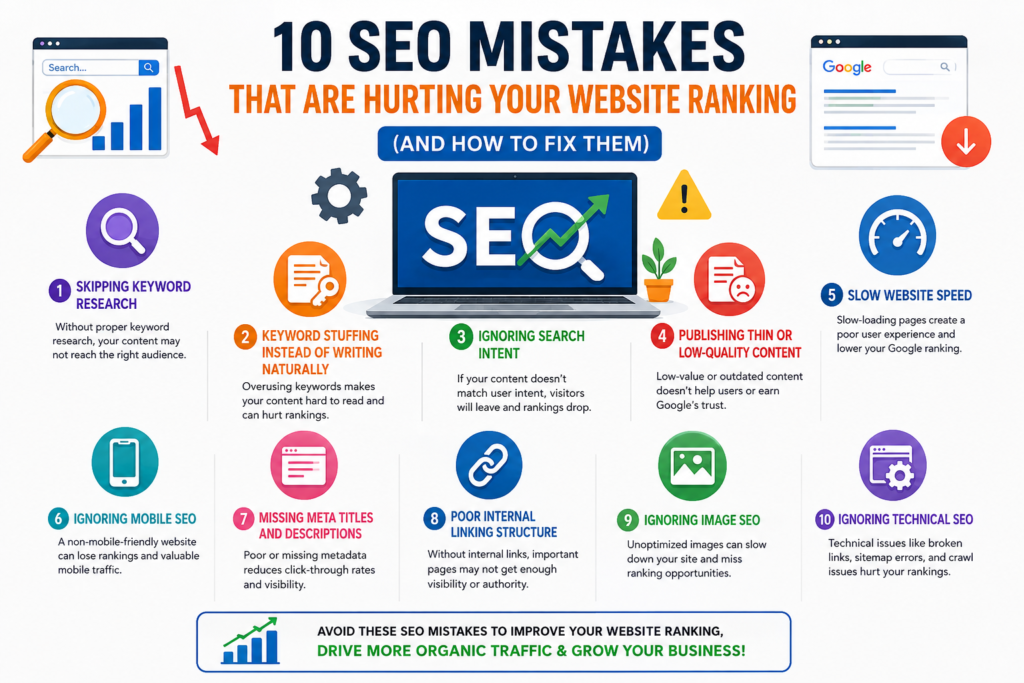
1-Using the Wrong Keywords
One of the most common SEO mistakes is targeting keywords that don’t match what your audience is actually searching for.
For example, a small local digital marketing agency may try to rank for a highly competitive keyword such as “digital marketing.” Competing against established websites for a broad keyword can be extremely difficult.
Instead, businesses should consider more specific and relevant keywords such as:
- Digital marketing agency in Lucknow
- SEO company in Lucknow
- Best SEO services for small businesses
- Affordable digital marketing services
The goal is not simply to find keywords with high search volume. You need keywords that match search intent, competition, and your target audience.
How to fix it
Research your target keywords before creating content. Look for a combination of primary keywords, secondary keywords, related terms, and long-tail keywords that genuinely match your products or services.
Keyword Stuffing
Keywords are important for SEO, but using the same keyword repeatedly can do more harm than good.
For example, repeatedly writing “best SEO company in Lucknow” in every paragraph can make your content sound unnatural. This is known as keyword stuffing.
Search engines have become much better at understanding context and topic relevance. Your content should be written primarily for people, not just search engines.
How to fix it
Use your primary keyword naturally in important locations such as:
- Page title
- Main heading
- Introduction
- Relevant subheadings
- URL
- Meta description
- Body content
Then use secondary and related keywords naturally throughout the article.
Ignoring Search Intent
Another major SEO mistake is creating content without understanding what the searcher actually wants.
Someone searching for “SEO mistakes” may want an informational article explaining common problems. Someone searching for “SEO agency near me” has a completely different intention and may be looking for a service provider.
If your content doesn’t satisfy the search intent behind a keyword, ranking can become much harder.
How to fix it
Before creating a page, search your target keyword on Google and study the type of results appearing. Are they guides, service pages, product pages, lists, or tutorials?
Create content that provides the type of information users are actually looking for.
4. Publishing Thin or Unhelpful Content
Simply publishing a blog does not guarantee higher rankings.
If an article contains very little useful information, repeats information from other websites, or doesn’t answer the reader’s questions, it may struggle to perform well.
Google’s systems aim to surface helpful, reliable and relevant content. Therefore, your focus should be on providing genuine value rather than simply reaching a particular word count.
How to fix it
Before publishing an article, ask:
- Does this answer the user’s main question?
- Have I covered important subtopics?
- Is the information easy to understand?
- Does the article provide practical advice?
- Can the reader take action after reading it?
A 1,000-word useful article can be more valuable than a 2,500-word article filled with unnecessary information.
5-Ignoring Title Tags and Meta Descriptions
Your title tag and meta description are important because they help users understand what your page is about when it appears in search results.
A generic title such as “Home” or “Our Services” gives search engines and users very little context.
How to fix it
Create a clear and relevant title that includes your main topic or keyword.
For example:
Common SEO Mistakes That Are Hurting Your Website Ranking
Your meta description should briefly explain what the page offers and encourage the searcher to click.
Avoid making the description misleading just to increase clicks. Your title and description should accurately represent the content on the page.
6-Having a Slow Website
Website speed is another important area of technical SEO.
If your website takes too long to load, users may leave before the page even appears. A slow website can also create a poor user experience, particularly for people browsing on mobile devices or slower connections.
Large images, unnecessary plugins, excessive scripts, poor hosting, and unoptimized website elements can contribute to slow loading times.
How to fix it
You can improve website performance by:
- Compressing images
- Using modern image formats where appropriate
- Removing unnecessary plugins
- Reducing unnecessary scripts
- Improving server performance
- Using browser caching
- Checking your Core Web Vitals
A faster website creates a better experience for visitors and gives your SEO strategy a stronger technical foundation.
7-Not Optimizing Your Website for Mobile
A large percentage of website traffic comes from mobile devices. If your website works well on a desktop but is difficult to use on a smartphone, you’re potentially losing both visitors and opportunities.
Common mobile SEO problems include tiny text, difficult navigation, buttons that are hard to tap, horizontal scrolling, and slow mobile loading.
How to fix it
Test your website on different screen sizes. Make sure your content is readable, buttons are easy to use, images display correctly, and visitors can navigate between pages without difficulty.
8-Ignoring Internal Linking
Internal links connect one page of your website to another. They help visitors discover related content and can also help search engines understand the structure and relationships between your pages.
For example, a blog about SEO mistakes could link naturally to another article about on-page SEO or keyword research.
How to fix it
Whenever you publish new content, look for relevant older pages that you can link to. Similarly, update older articles with links to useful new content.
Use descriptive anchor text instead of generic phrases such as “click here.”
9-Having Broken Links and Poor Website Structure
Broken links create a frustrating experience for visitors and can make it harder for search engines to crawl your website effectively.
A complicated website structure can also make important pages difficult to discover.
How to fix it
Regularly check your website for broken internal and external links. Keep your navigation simple and organize your content logically.
Ideally, important pages should be accessible through your site’s navigation and internal linking structure.
10-Duplicate Content
Duplicate or substantially similar content across multiple URLs can make it difficult for search engines to determine which version should be shown in search results.
This doesn’t mean that every repeated phrase is automatically a serious SEO problem. However, having multiple pages targeting the same topic with nearly identical content can create unnecessary confusion.
How to fix it
Review similar pages and determine whether they should be combined, improved, redirected, or handled using appropriate canonicalization where necessary.
Focus on creating unique pages with a clear purpose.
11. Ignoring Image SEO
Images can improve the user experience, but unoptimized images can also slow down your website.
Many websites also forget to provide meaningful alternative text for important images.
How to fix it
Use descriptive image file names, compress images before uploading them, choose appropriate dimensions, and add useful alt text when it helps explain the image.
Avoid stuffing keywords into alt text.
12. Expecting Results Too Quickly
SEO is not an overnight marketing strategy.
One of the biggest mistakes businesses make is publishing a few articles, waiting several weeks, and assuming SEO doesn’t work.
Your website needs time to build authority, earn relevant links, improve content, and demonstrate consistent value.
How to fix it
Track your SEO performance consistently. Monitor organic traffic, keyword visibility, impressions, clicks, conversions, and important technical issues.
Use the data to improve your strategy instead of making random changes every few days.
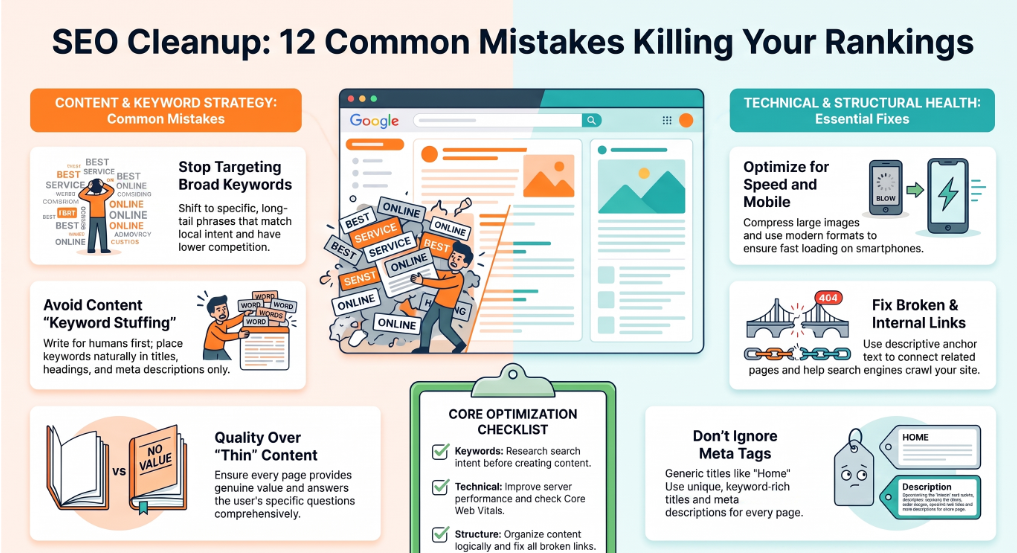
How to Avoid Common SEO Mistakes
Avoiding SEO mistakes requires a combination of content optimization, technical improvements, keyword research, and continuous monitoring.
Start with the basics:
- Research relevant keywords.
- Understand search intent.
- Create genuinely useful content.
- Optimize title tags and meta descriptions.
- Improve website speed.
- Make your website mobile-friendly.
- Build a logical internal linking structure.
- Fix broken links.
- Optimize images.
- Monitor your website performance regularly.
Remember that SEO is not about finding one trick that suddenly makes your website rank #1. It is about building a website that is technically accessible, useful, relevant, trustworthy, and easy for both users and search engines to understand.
Final Thoughts
The common SEO mistakes that are hurting your website ranking are often not one major problem. Instead, several small issues can work together to limit your website’s organic performance.
From targeting the wrong keywords and stuffing content with keywords to having a slow website, poor internal linking, weak content, and ignoring mobile optimization, these mistakes can prevent your website from reaching its potential.
The good news is that most SEO problems can be identified and improved with the right strategy.
If your website isn’t ranking as expected, don’t immediately assume that you need more content. Start by auditing what you already have. Identify the technical, content, and on-page SEO issues that may be holding your website back—and fix them systematically.
Better SEO starts with fewer mistakes, better content, and a website built around what your audience actually needs.